Thrive® Aquarium Fertilizer
Every nutrient a planted tank needs, out of one pump
One 2 mL pump per 10 gallons carries nitrogen, phosphorus, potassium, magnesium, chelated iron and trace elements into the water column together. No separate nitrate, phosphate, potassium and trace bottles, and no weighing dry salts on a kitchen scale.
Which Thrive Fertilizer Should You Use?
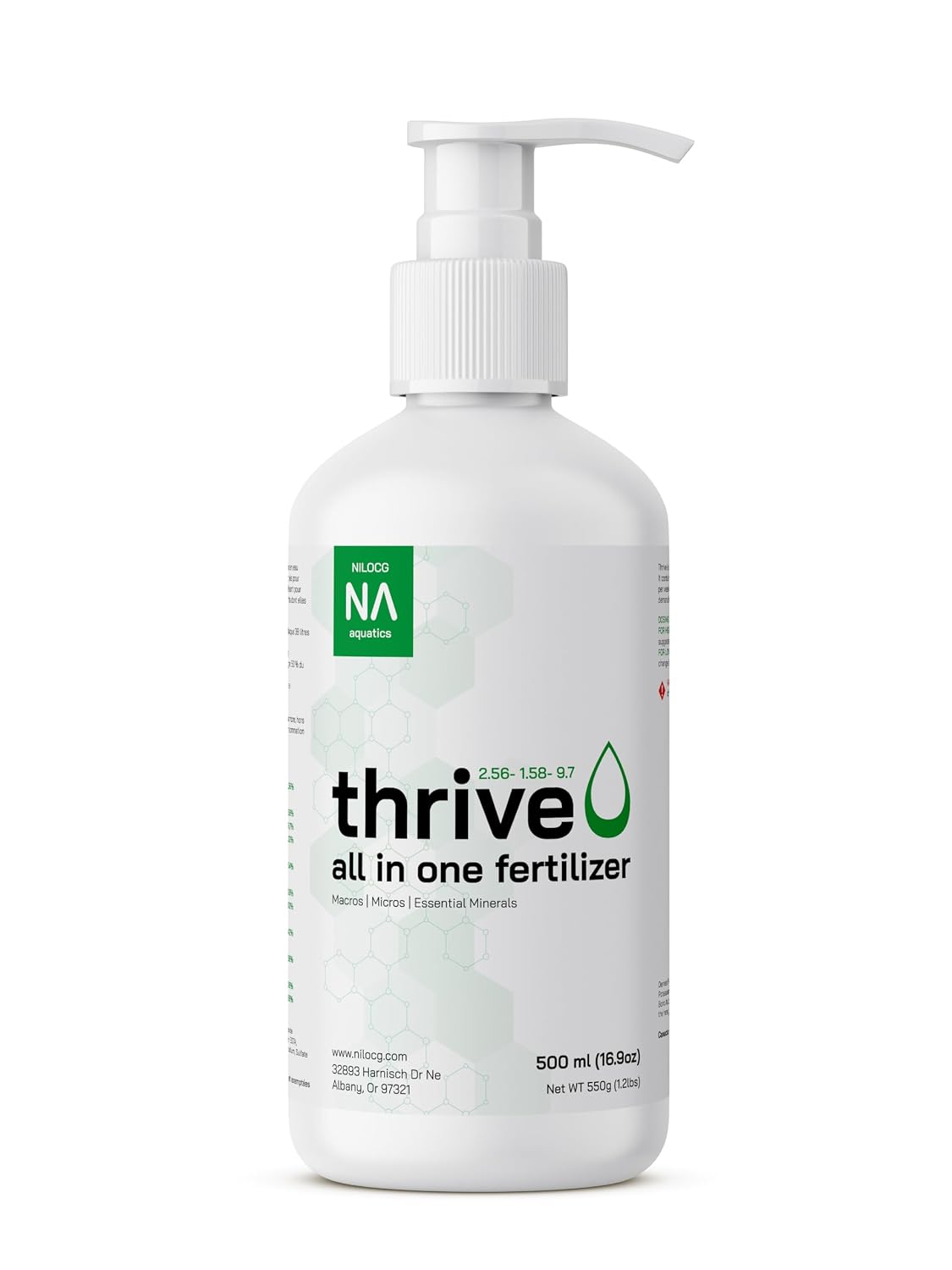
The default choice
Thrive
Most planted freshwater tanks, low-tech or high-tech, at any pH.
Nitrogen, phosphorus, potassium, magnesium, iron and trace elements in one liquid. Start here unless the aquarium gives you a specific reason to pick one of the others.
- 6 ppm nitrate
- 1.1 ppm phosphate
- 5 ppm potassium
- 0.25 ppm iron
1 pump (2 mL) per 10 gallons
Check price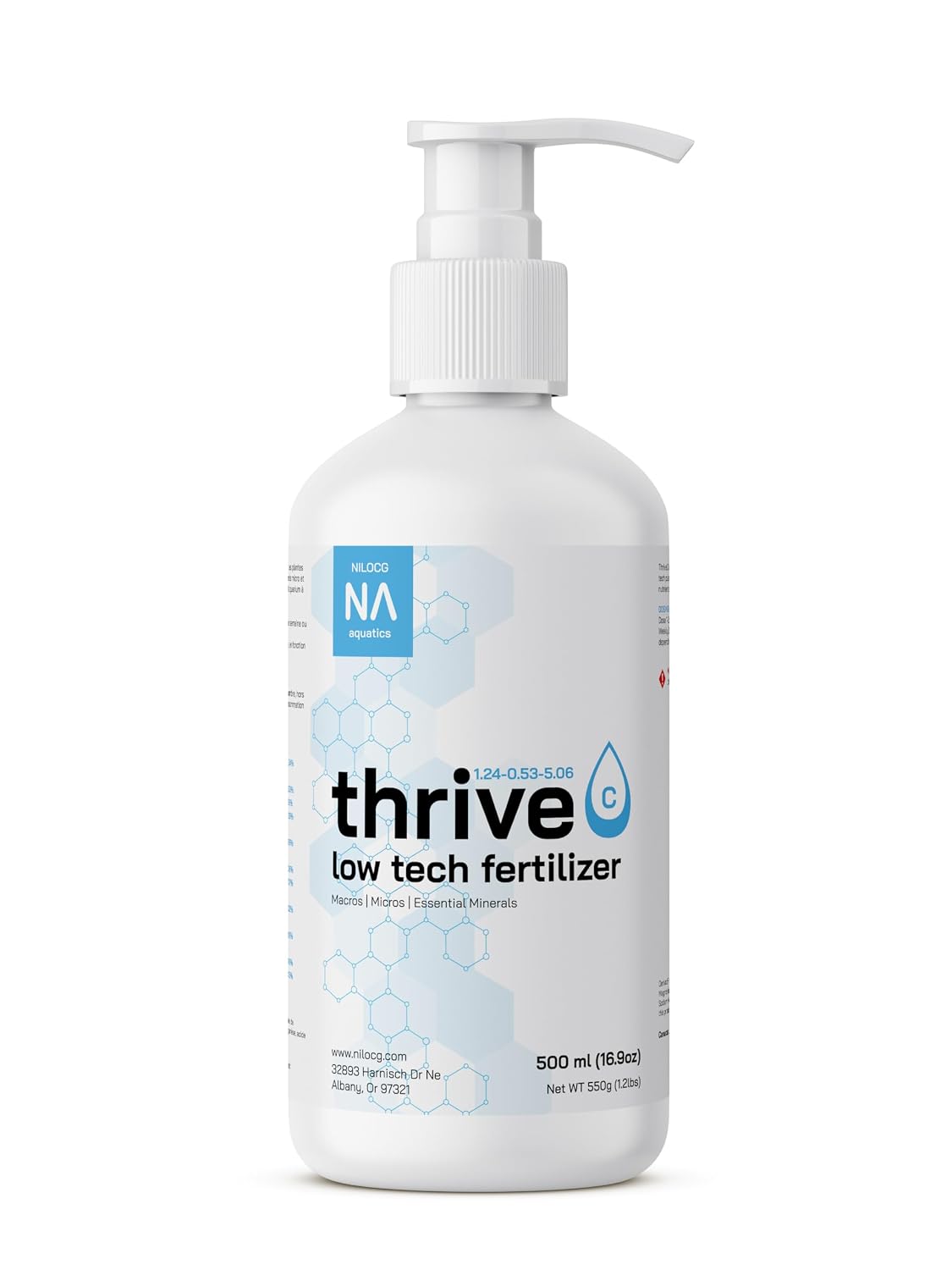
Leaner on nitrate
Thrive C
Low-tech tanks, and any aquarium where fish load already keeps nitrate up.
Cutting a regular all-in-one dose to control nitrate also cuts the potassium, iron and traces the plants still want. Thrive C changes the ratio instead, and adds a non-glutaraldehyde carbon source.
- 1.24% nitrogen
- 0.53% phosphate
- 5.06% potash
- 0.32% iron
1 pump (1 mL) per 5 gallons
Check price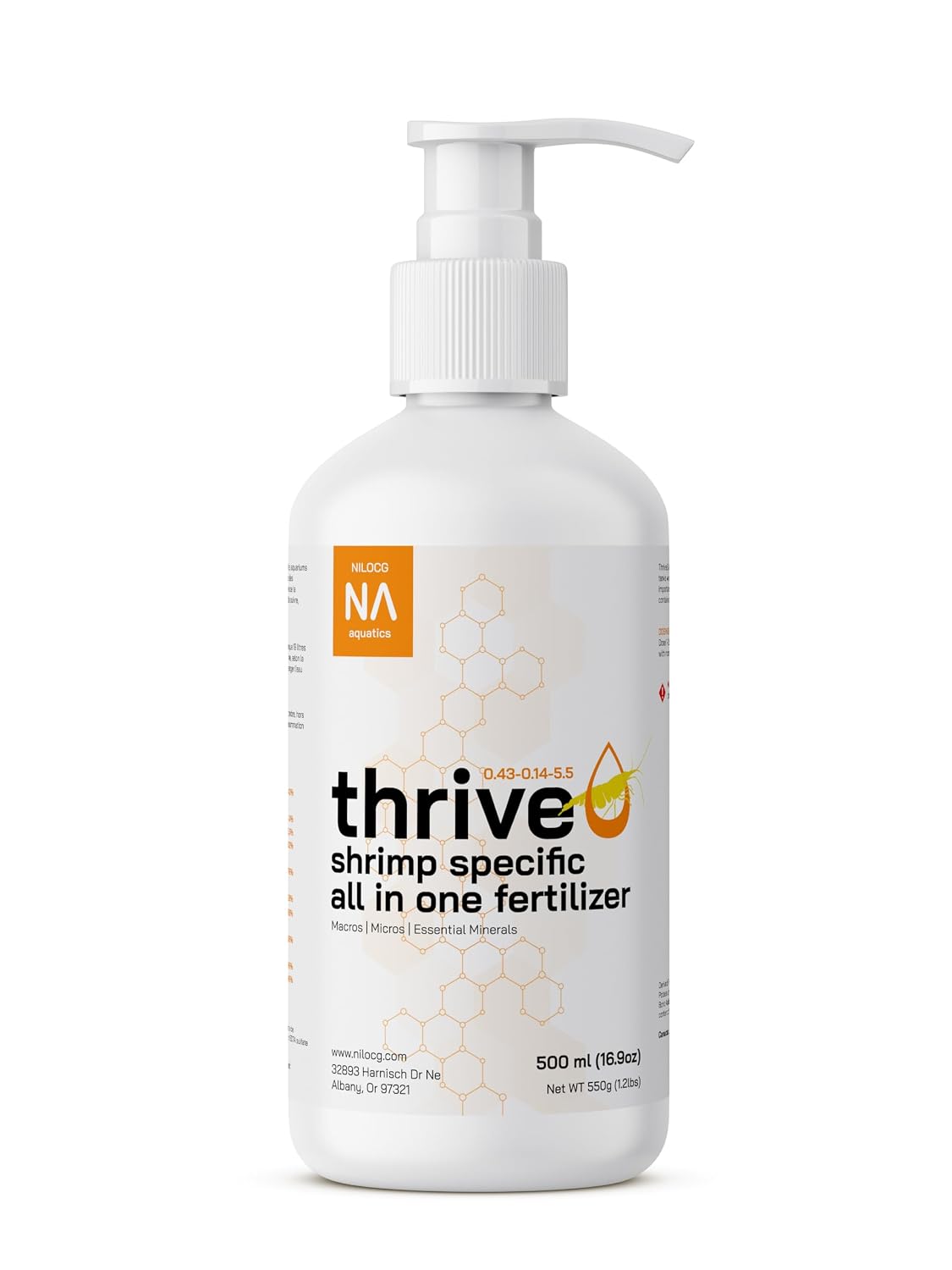
No added copper
Thrive S
Planted shrimp tanks, where water stability outranks maximum plant growth.
The guaranteed analysis carries no copper, and nitrogen and phosphate run far below the main formulas. Plants still get broad nutrition without pushing a shrimp tank into a heavy water-change routine.
- 0.43% nitrogen
- 0.14% phosphate
- 5.5% potash
- 0.38% iron
1 pump per 5 gallons
Check priceThe full Thrive line
| Product | Built for | Dose | Nitrogen | Iron |
|---|---|---|---|---|
| Thrive | Most planted freshwater tanks | 1 pump / 10 gal | 6 ppm NO3 | 0.25 ppm Fe |
| Thrive+ | High-tech, pH around 7 or below | 1 pump / 10 gal, 1 to 3x weekly | 7.5 ppm NO3 | 0.4 ppm Fe |
| Thrive C | Low-tech, or nitrate already high | 1 pump / 5 gal, 1 to 2x weekly | 1.24% N in bottle | 0.32% Fe in bottle |
| Thrive S | Planted shrimp tanks | 1 pump / 5 gal, 1 to 3x weekly | 0.43% N in bottle | 0.38% Fe in bottle |
| ThriveCaps | Root zone, under the substrate | 1 capsule every 5 to 6 in | 2.57% N in capsule | 2.47% Fe in capsule |
Thrive+ is the stronger liquid, for high-tech tanks running around pH 7 or below. ThriveCaps are capsules pushed into the substrate for rooted plants like cryptocoryne, echinodorus and vallisneria.
What One Pump of Thrive Adds
6ppm
Nitrate (NO3)
Nitrogen for chlorophyll, proteins and new leaves. The nutrient a fast-growing stem tank burns through first.
1.1ppm
Phosphate (PO4)
Phosphorus drives energy transfer inside the plant. Small numbers, and growth stalls without it.
5ppm
Potassium (K)
The gap fish waste leaves behind. Feeding more will not fix a potassium shortage.
0.25ppm
Iron (Fe)
Chelated with DTPA and EDTA so it stays available in aquarium water instead of dropping out on contact.
Those figures are one 2 mL pump of original Thrive in 10 gallons. The bottle itself is far more concentrated, which is what lets 500 mL cover 2,500 gallons of cumulative dosing.
| Guaranteed analysis | Thrive All-in-One |
|---|---|
| Total nitrogen (N) | 2.56% |
| Available phosphate (P2O5) | 1.58% |
| Soluble potash (K2O) | 9.74% |
| Iron (Fe) | 0.42% |
| Also declared | Magnesium, sulfur and trace elements |
| Iron sources | DTPA and EDTA chelates |
| Derived from | Potassium nitrate, potassium phosphate, potassium sulfate, potassium chloride, magnesium sulfate |
| Dosing basis | Estimative Index (EI) |
Iron supports chlorophyll and several metabolic processes, and correcting a genuine iron shortage is worth doing. Piling on more of it will not turn a rotala red on its own. Light, CO2, nitrogen availability and the species itself decide most of that.
How to Dose Thrive Fertilizer
Measure the water, not the box
Substrate, rock and wood push water out of the tank. A 20 gallon aquarium under a thick hardscape can hold a good deal less than 20 gallons, so a heavily scaped layout is worth starting slightly under the label rate.
Dose at the labeled rate
One 2 mL pump of Thrive per 10 gallons. Thrive+ matches that rate, one to three times a week. Thrive C and Thrive S both work off 5 gallons per pump.
Judge the new growth
Leaves that formed three weeks ago will not repair themselves once a deficiency is corrected. Whatever grows after the change is the only honest read on whether it worked.
Change one thing at a time
Doubling fertilizer, extending the photoperiod and turning the light up on the same afternoon leaves you with no idea which one mattered. Consistency beats a new adjustment every few days.
Go easy in a new tank
A mature stem tank strips nutrients out of the water fast. A fresh aquascape with bare substrate between the plants cannot, so the same schedule does not suit both. Build the dose up as the plant mass fills in.
Keep changing water
Plants consume each nutrient at its own pace, so repeated dosing without a reset slowly drifts the water away from the ratio in the bottle. Thrive C guidance puts weekly changes around 20% to 30%.
Melting is not always hunger
Pale growth and stalled stems can point at nutrients. Poor CO2 distribution, damaged roots, extreme hardness and a badly chosen species look much the same. Check the rest of the system before dosing harder.
What Planted Tank Keepers Say
Excellent and cost-effective. I'm using this in a 20 gallon long tank. Had some jungle val I put in the tank in March, 6 months later it had barely grown any - and from what I've seen and heard, that's super un...
Amanda
Thrive has become my favorite liquid fertilizer. I had been losing many plants when I was just using Flourish and root tabs but after switching to this I’ve had no more melt and my plants are finally growing. I...
Nick
This fertilizer is amazing. I have a low tech tank, aka an led light thats on for about 5 hrs a day and no co2 or anything of the sorts. I have a bacopa, Java fern, and amazon sword. Even though the amazon swor...
Heidi
My plants absolutely love this stuff and it is so easy for me to use. I admit I am pretty forgetful and lazy when it comes to fertilizing, so the Thrive line of liquid fertilizers are right up my alley. I have...
Liz
I've only been using this fert for a week and I'm already seeing some pretty fast results. I have a heavily planted 10g tank for a very spoiled betta. My plants were doing fairly well until suddenly things st...
Perilous
Great value & highly recommended! I’m thankful to find great products like this at such amazing prices & good quality. This may seem a little pricey to some but it’s a must buy for those with live aquarium plan...
C. Stewart
Low-Tech, High-Tech and CO2
Low-tech tanks
A tank with no injected CO2 grows more slowly, so it eats less. Livestock also hands it a real share of the nitrogen and phosphorus, which is exactly where copying a high-tech schedule turns wasteful.
Original Thrive works here when a broad fertilizer is what the tank needs. Thrive C is the sharper pick when nitrate already runs high from stocking and feeding. Driving test readings as high as possible is not the goal.
High-tech tanks
Strong light plus injected CO2 changes the arithmetic. Growth accelerates, fertilizer disappears faster, and a weekly trim carries a good deal of biomass out of the system for good.
Thrive+ was built for that tank, with more iron and two nitrogen sources at pH 7 or below. A low-tech aquarium does not get healthier just because it received the strongest bottle in the range.
CO2 is not compulsory. Low- and medium-light tanks grow fine without it. Push the light hard enough and carbon becomes the limiting factor instead, at which point more fertilizer changes nothing.
Thrive in a Planted Shrimp Tank
Copper is the reason this question comes up, and the answer splits two ways. Thrive, Thrive+ and Thrive C can be used in aquariums that contain shrimp. Original Thrive and Thrive+ do carry a small amount of copper as a trace element, at the level plants need it.
Thrive S is the formula for tanks where the shrimp are the point. Its guaranteed analysis lists no copper at all, and nitrogen and phosphate sit far below the main bottles, at 0.43% N and 0.14% available phosphate against 5.5% soluble potash and 0.38% iron.
The real difference is the maintenance style. A plant-first aquascape tolerates big nutrient inputs and the large water changes that reset them. Most caridina keepers would rather move slowly and keep parameters flat, and Thrive S fits fertilization into that routine instead of fighting it.
Fertilizer is still not remineralization. GH, KH and TDS targets belong to the shrimp species you keep, and a shrimp-specific mineral product is what sets them.
Soft water and RO/DI
Very soft tap water and RO/DI water can run short of calcium and magnesium, and a GH booster is the recommended fix alongside Thrive. General hardness is mostly those two minerals, which is a separate job from feeding nitrogen, phosphorus, potassium and traces.
Test before you add one. Source water that already has sensible GH will overshoot if a booster goes in automatically.
Water Column or Root Tabs
Liquid Thrive spreads nutrients through the water, where leaves, stems and roots all reach them. That suits epiphytes and anything not planted in rich substrate. Anubias, java fern, mosses and most stem plants take a large share of their nutrition straight out of the water column.
ThriveCaps put the same nutrients under the substrate instead. Each 60-count package combines dry Thrive nutrients with iron-rich clay and mineralized topsoil, at 2.57% nitrogen, 1.69% available phosphate, 10.1% soluble potash and 2.47% iron. Push one in near a plant, or space them every 5 to 6 inches through a planted area, and replace them after roughly 3 to 4 months.
Plenty of tanks want both. Established cryptocoryne, echinodorus and vallisneria make heavy use of root-zone feeding, while an anubias tied to driftwood depends on what is dissolved around it. The two methods answer different halves of the same question.
How Long a Bottle Lasts
500 mL
Pump bottle
Up to 2,500 gallons of cumulative dosing
The practical starting point for one aquarium. At two pumps a week on a 20 gallon tank, a bottle lasts well over a year.
Check price2,000 mL
Refill jug
Up to 10,000 gallons
Refills the pump bottle four times. Worth it once the tank is large enough, or once there is more than one of them.
Check price4,000 mL
1 gallon refill
Around 19,000 gallons
The lowest cost per dose in the range. Built for fish rooms, several planted tanks, or years of dosing a big display.
Check priceThose gallon figures are cumulative dosing, not tank size. A 10 gallon low-tech aquarium dosed once a week will outlast several high-tech tanks on the same bottle by years.
Thrive Is a NilocG Aquatics Product
NilocG Aquatics started as a hobby operation with one goal: make fertilizing a planted tank simple enough that people actually keep doing it. The company outgrew a spare bedroom and now runs from a 6,000 square foot warehouse in Albany, Oregon, supplying hobbyists, shops and private-label customers.
That fertilizer-first history is visible in the product line. Thrive covers the broad middle of the hobby. Thrive+ answers faster high-tech growth. Thrive C reproportions the nutrients for low-tech and high-bioload tanks. Thrive S adapts the idea to shrimp keeping, and ThriveCaps take it below the substrate.
Five products exist because one nutrient profile cannot be right for every aquarium. The original formula follows the Estimative Index, which keeps nutrients available rather than letting a single element run out and cap growth, and turns that into a pump instead of a scale and a set of dry salts.
Frequently Asked Questions
Thrive is a concentrated all-in-one liquid fertilizer for freshwater planted aquariums. It supplies macro and micronutrients in a single dose, including nitrogen, phosphorus, potassium, magnesium, iron and trace elements. The original formula is based on the Estimative Index approach, which keeps essential nutrients available so plant growth is not limited by a missing element.
Original Thrive is the general-purpose choice for most planted freshwater aquariums. Thrive+ is intended for high-tech tanks around pH 7 or below. Thrive C uses lower nitrate and phosphate levels for low-tech tanks or aquariums with a high bioload. Thrive S is formulated specifically for planted shrimp tanks.
Thrive works across a broad range of planted tanks and pH levels. Thrive+ is aimed at high-tech aquariums around pH 7 or below and contains more iron plus two forms of nitrogen. At the standard dose, Thrive adds about 6 ppm nitrate and 0.25 ppm iron per 10 gallons. Thrive+ adds about 7.5 ppm nitrate and 0.4 ppm iron per 10 gallons.
Thrive C is designed for lower-tech planted aquariums and tanks where fish load already keeps nitrate relatively high. It provides the rest of the nutrient profile without adding as much nitrate and phosphate as the stronger Thrive formulas. Thrive C also contains a non-glutaraldehyde source of bioavailable carbon.
Thrive S is built around the maintenance requirements of shrimp-focused aquariums. Its formula contains no added copper and uses lower nitrogen and phosphate concentrations than the main Thrive formulas. This allows plants to receive broad nutrition without requiring the same high-input fertilization and water-change routine commonly used in plant-focused aquascapes.
Yes. Thrive, Thrive+ and Thrive C can be used in aquariums containing shrimp. Thrive S exists for tanks where shrimp are the primary focus and water stability takes priority over aggressive plant fertilization. For a plant-focused aquarium that happens to contain shrimp, one of the other Thrive formulas may still be the better fit.
For most aquariums, a Thrive all-in-one formula is intended to cover the main macro and micronutrient requirements without separate bottles of nitrate, phosphate, potassium or trace fertilizer. Soft water and RO/DI setups are the main exception. These tanks may need additional calcium and magnesium through a GH booster.
For original Thrive, one pump is 2 mL and treats 10 gallons. That dose adds approximately 6 ppm nitrate, 1.1 ppm phosphate, 5 ppm potassium and 0.25 ppm iron. Actual frequency can be adjusted for plant mass, lighting, CO2 and nutrient consumption rather than assuming every aquarium needs the same schedule. Thrive+ is dosed at one pump per 10 gallons, 1 to 3 times weekly. Thrive C uses one 1 mL pump per 5 gallons, generally 1 to 2 times weekly. Thrive S is dosed at one pump per 5 gallons, 1 to 3 times weekly.
A 500 mL bottle can treat up to 2,500 gallons of cumulative water volume at the standard dose. The 2,000 mL refill treats up to 10,000 gallons, and the 4,000 mL size treats approximately 19,000 gallons. Calendar life depends on tank size and dosing frequency, so a bottle can last many months in a smaller aquarium.
No. Low- and medium-light planted aquariums can use Thrive without pressurized CO2. As light intensity increases, plants grow faster and carbon demand rises. In a high-light aquarium, atmospheric CO2 alone may eventually become the limiting factor even when fertilizer is available.
Sometimes, but usually not for a tank with meaningful plant growth. Fish food and waste can supply substantial nitrogen and phosphorus, particularly in low-tech aquariums, but they are comparatively poor sources of potassium and iron. As plant mass or light intensity increases, relying entirely on livestock waste becomes less reliable.
Yes, but the water may also need remineralization. Thrive supplies some magnesium and calcium, and a GH booster is recommended for soft water and RO/DI setups to provide adequate amounts of those minerals. Fertilizer dosing and water remineralization solve different problems, so one should not be treated as a substitute for the other.
ThriveCaps are root-zone fertilizer capsules placed directly into aquarium substrate. They contain concentrated Thrive nutrients combined with iron-rich clay and mineralized topsoil. A capsule can be placed near an individual plant or spaced approximately every 5 to 6 inches through a planted area, then replaced after about 3 to 4 months as needed. They are particularly useful for established rooted plants that can draw substantial nutrition from the substrate.
Yes. They feed plants through different parts of the aquarium. Liquid Thrive distributes nutrients through the water column, while ThriveCaps concentrate nutrients around the roots. Using both can make sense in tanks that combine water-column feeders with heavily rooted species. Dose according to actual plant demand rather than automatically maximizing both sources.
Thrive is made by NilocG Aquatics. The company began as a small aquarium hobby operation centered on simplifying planted-tank fertilization. It later expanded from an extra bedroom into a 6,000-square-foot facility with four full-time employees, serving direct customers and other businesses and producing custom private-label products.
Feed the Nutrients Fish Waste Misses
Fish waste covers some of the nitrogen and phosphorus and almost none of the potassium and iron. Thrive closes that gap in one pump, and picks up magnesium and the trace elements on the way through.
Shop Thrive Aquarium Fertilizer